


Most homeowners believe the number on their fertiliser spreader dial is a universal standard; however, relying on that factory setting alone is often the quickest way to ruin a healthy lawn. It is understandable to feel a sense of trepidation when applying concentrated nutrients. No one wants to deal with the frustration of scorched patches or those tell-tale yellow stripes that highlight every missed pass. You simply want a lawn that looks consistently lush and professional without the guesswork.
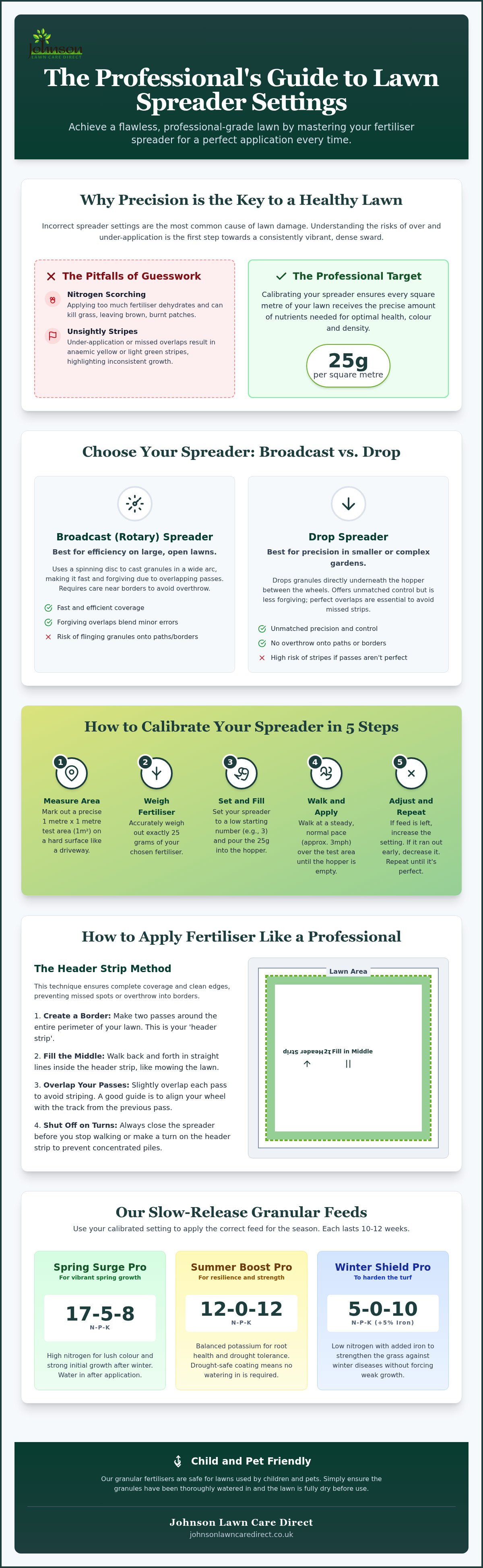
This lawn spreader settings guide provides the professional framework you need to calibrate your equipment for perfectly even coverage. Whether you are applying the nitrogen-rich Spring Surge Pro (17-5-8) or preparing for the colder months with Winter Shield Pro (5-0-10), precision is the key to success. We will explain how to adjust for different brands, why walking speed matters, and how to ensure you are delivering exactly 25 grams per square metre every time. By following these methodical steps, you can move away from trial and error and towards the dense, vibrant garden you deserve.
Key Takeaways
- Understand how to prevent nitrogen scorching and unsightly stripes by moving beyond generic manufacturer recommendations.
- Learn the step-by-step process to calibrate your equipment for an accurate 25 grams per square metre application rate using this lawn spreader settings guide.
- Discover the functional differences between broadcast and drop spreaders to ensure you select the most efficient tool for your garden.
- Apply seasonal feeds like Spring Surge Pro (17-5-8) and Summer Boost Pro (12-0-12) with precision to maintain health for up to 12 weeks.
- Master professional application methods; such as the header strip technique; to achieve a uniform finish across your entire lawn.
Why Correct Lawn Spreader Settings are Essential for Even Growth
Precision is the difference between a professional finish and a patchy mess. This lawn spreader settings guide exists because "close enough" isn't sufficient for high-quality nutrition. If settings are too high, you risk nitrogen scorching; a concentrated dose of nutrients that can dehydrate and kill grass blades. Conversely, settings that are too low result in an anaemic appearance. You will see unsightly light and dark green stripes where the grass has missed its required dose. A uniform application ensures every blade receives the same support for root strength and leaf colour.
The Science of Granule Flow and Spreader Apertures
Professional granular feeds like Spring Surge Pro (17-5-8) are engineered for a consistent flow. Unlike cheaper retail alternatives that often contain dust and irregular chunks, these granules have a uniform size and weight. This uniformity is vital for understanding fertilizer basics and how nutrients are released steadily over 10 to 12 weeks. The aperture, the opening at the bottom of your hopper, relies on gravity and movement. Environmental factors like high humidity can make granules slightly tacky, which reduces the flow rate even if your dial remains unchanged. This is why a setting of 5 on one brand of equipment rarely matches a 5 on another; the mechanical design and hole shape differ significantly.
Avoiding the Pitfalls of Uneven Application
Achieving the 25g/m² target is your primary defence against lawn damage. When settings are incorrect, you often see "lion tails" where fertiliser has piled up during a slow turn. These concentrated patches are high in nitrogen and will likely scorch the turf. A healthy, dense lawn is the most effective way to prevent weeds and moss from taking hold; however, achieving that density requires every square metre to receive an identical amount of feed. If you have existing weeds, products like Weedol can help as a secondary measure, but consistent nutrition through the Lawn Envy System is what builds the long-term resilience of the sward. Turning your Fertiliser Spreader off before you stop or turn is a simple professional habit that prevents these common pitfalls. Accurate calibration ensures you get the maximum value from your professional feed programme while maintaining a safe environment for children and pets once the granules are watered in and dry.
Understanding Broadcast and Drop Spreader Mechanisms
Selecting the correct mechanical delivery system is just as vital as the quality of the fertiliser itself. The two primary tools available to UK homeowners operate on very different principles, and your choice will largely depend on your garden layout and the size of your lawn. A broadcast spreader, often called a rotary spreader, uses a spinning disk to distribute granules in a wide arc. This mechanism is inherently more forgiving; the overlapping throw patterns naturally blend together, which helps to mask minor inconsistencies in your walking path. This efficiency makes it a lawn spreader settings guide favourite for larger lawns where uniform coverage is the priority.
Broadcast Spreaders for Efficiency and Large Areas
Broadcast spreaders are the preferred tool for applying Summer Boost Pro (12-0-12) across expansive areas. Because the granules are thrown several metres wide, you can cover a significant sward with fewer passes. However, you must manage the edges with care. Without a side shield, the spinning disk can easily fling fertiliser into flower borders or onto gravel paths, leading to waste and potential staining. Understanding how to calibrate your spreader is essential for these models, as your walking speed directly influences both the width and the density of the distribution. Maintaining a steady 3 mph pace is the professional standard for ensuring the granules land exactly where they are needed.
Drop Spreaders for Precision and Small Lawns
For smaller gardens or lawns with narrow strips of grass, a drop spreader offers unmatched precision. These machines drop fertiliser directly beneath the hopper between the wheels. There is no throw to account for; the granules land exactly where you walk. This precision makes it easy to avoid paths and borders, but it requires a higher degree of concentration. Because the distribution has a sharp edge, you risk leaving missed strips if your passes do not overlap perfectly. Unlike broadcast models, drop spreaders leave very little room for error. If your lawn spreader settings guide calibration is slightly off, you will see distinct lines of growth within days. This tool is excellent for controlled applications, but it demands a methodical, straight walking path to avoid a "zebra" effect on the turf.
If you are looking to simplify your annual maintenance and achieve professional-grade results, following a structured programme like the Lawn Envy System provides the consistency your grass needs to thrive through every season.
How to Calibrate Your Spreader for a 25g/m² Application Rate
Generic manufacturer charts are often misleading because they cannot account for the unique way you handle your equipment. A lawn spreader settings guide provided by a manufacturer is typically based on a specific walking speed and a factory-new machine; however, your own pace and any slight wear in the aperture mechanism will alter the flow rate. To ensure you are applying exactly 25 grams per square metre, you must perform a physical calibration. This process requires a tape measure, a set of digital scales, and a collection sheet or a clean, swept driveway. Calibrating at the start of every growing season is essential, as the flow characteristics of granular feeds can change based on storage conditions and humidity.
The Professional Ten Metre Calibration Test
While some sources suggest a one metre square test, this is often too small to account for the natural variations in your stride. A ten metre test provides a much more accurate reflection of your actual application rate. Follow these steps to verify your settings:
- Step 1: Measure a ten metre strip on a clean, hard surface or a large plastic sheet.
- Step 2: If your Fertiliser Spreader has a one metre distribution width, weigh out 250 grams of your granular feed.
- Step 3: Walk the strip at your normal, comfortable pace and weigh the product remaining in the hopper.
By subtracting the remaining weight from your starting 250 grams, you can see exactly how much was applied over that ten square metre area. If you have used more than 250 grams, you must close the aperture slightly; if you have used less, open it further. Repeat the test until you reach the target consistently. This methodical approach ensures you achieve the same results as a professional groundsman.
Adjusting Settings for Different Walking Speeds
Your walking speed is the most significant variable in the calibration equation. A brisk walk covers more ground in less time, meaning the aperture must be wider to release the required 25 grams per square metre. If you prefer a slower, more deliberate stroll, you will need a smaller setting to prevent over-application and the risk of scorching. Learning how to calibrate your fertilizer spreader allows you to match the equipment to your natural movement rather than trying to force an uncomfortable pace. Once you have found your rhythm, maintain it throughout the entire garden. Consistency is more important than speed. For those seeking a deeper understanding of these professional techniques, The Lawn Envy Masterclass offers comprehensive guidance on perfecting your application skills.
Spreader Guidance for the Lawn Envy System Feeds
Every seasonal feed in the Lawn Envy System has a specific NPK ratio and granule density. These physical characteristics dictate how the product flows through your equipment. A lawn spreader settings guide should not treat all fertilisers as identical; instead, it must reflect the unique requirements of each season to maintain health without the risk of scorching. Achieving a consistent application ensures that nutrients are released steadily over 10 to 12 weeks, providing the root strength and leaf colour required for a professional finish.
Settings for Spring and Summer Nutrition
Spring Surge Pro (17-5-8) is engineered to activate with warmth and moisture; providing a controlled release of nitrogen to kickstart the growing season. Applying this feed at the standard 25 grams per square metre ensures the sward thickens without causing an unmanageable growth surge. As we move into the warmer months, Summer Boost Pro (12-0-12) becomes the primary choice for maintaining vitality. This formulation is the only granular feed in our range that does not require watering in due to its specialised drought-safe coating. You can apply it with confidence even during dry spells; provided your spreader is calibrated to the correct 25g/m² rate to avoid uneven greening or stripes.
Adjusting for Winter Protection and Moss Control
The requirements change significantly as the seasons turn and the weather cools. Winter Shield Pro (5-0-10) contains 5% iron to suppress moss and harden the grass against frost. While most of our feeds use the 25g/m² standard, Winter Shield Pro often requires a higher application rate of 35-40 grams per square metre for effective moss control. This increase in volume means you must adjust your lawn spreader settings guide calculations to allow for a wider aperture. The higher iron content also changes the granule density; making the product slightly heavier than the nitrogen-rich spring feeds. It is essential to water this feed in within a couple of days to activate the iron and protect the grass blades.
For those establishing new grass or repairing patches, Seed Start Pro (6-10-8) uses a phosphate-heavy ratio to encourage rapid root development. Like the spring and autumn feeds, it should be applied at 25g/m² and watered in within 48 hours if rain is not forecast. All these granular products are child and pet friendly once they have been watered in and the lawn is dry. By understanding these seasonal nuances, you ensure your lawn remains dense and resilient; which is your best natural defence against weeds and moss throughout the year.
How to Apply Granular Fertiliser Like a Professional
Mastering your equipment is only half the battle. Even with a calibrated lawn spreader settings guide, your physical technique on the grass determines whether you achieve a professional finish or a striped mess. Applying granular, slow-release fertiliser requires a methodical approach that prioritises consistency over speed. By adopting the same habits used by professional greenkeepers, you can ensure every square metre of your garden receives the exact nutrients it needs to thrive through the seasons.
The Header Strip and Turning Technique
Applying fertiliser around the perimeter first is a technique known as the header strip. Walk two full passes around the entire boundary of your lawn to create a turning zone at each end of your main rows. When you reach the edge of the grass, you can close the aperture whilst still inside this header strip, turn your Fertiliser Spreader, and begin the next row. It is vital to ensure the spreader is already in motion before you open the aperture; conversely, you must close it before you stop walking. This prevents the concentrated piles of granules that often lead to nitrogen scorching when a spreader is stationary.
The Half-Rate Cross-Hatch Method for Even Results
For the most uniform results, we recommend the half-rate cross-hatch method. Instead of applying the full 25 grams per square metre in a single pass, set your equipment to half that rate, which is 12.5g/m². Apply the first half of your fertiliser in north-south rows across the entire lawn. Once complete, apply the remaining half in east-west rows. This overlapping pattern effectively eliminates any missed spots and ensures a perfectly even distribution of nutrients. For a visual demonstration of these professional techniques, The Lawn Envy Masterclass provides detailed video guidance to help you perfect your form.
Post-Application Care and Safety
Once the application is complete, post-care is straightforward but essential for activating the nutrients. Most of our feeds, such as Spring Surge Pro (17-5-8) and Autumn Guard Pro (17-5-20), should be watered in within a couple of days if rain is not forecast. Summer Boost Pro (12-0-12) is the only exception; its drought-safe coating allows it to sit safely on the surface until the next rainfall. All products in our range are child and pet friendly. The lawn is safe to use as soon as the feed has been watered in and the grass blades have dried. Maintaining a healthy, dense lawn through consistent feeding is your primary defence against weeds and moss, keeping your garden vibrant for the next 10 to 12 weeks.
Achieve Professional Lawn Excellence with Precision
Mastering your equipment is the final step in transforming your garden into a professional-standard sward. By moving beyond generic manufacturer charts and using this lawn spreader settings guide; you ensure that every granule of slow-release feed is distributed with absolute accuracy. This precision protects your grass from the risks of nitrogen scorching and unsightly stripes; allowing the nutrients to activate with warmth and moisture for sustained health. Taking the time to calibrate ensures you get the maximum value from your seasonal programme whilst maintaining a safe environment for your family.
Using a dedicated Fertiliser Spreader designed for professional-grade granular feeds makes this process remarkably simple. These tools are built with durable construction for year-round use and are specifically engineered to be easy to calibrate for the Lawn Envy System. Whether you are applying Spring Surge Pro (17-5-8) to kickstart growth or hardening the turf with Winter Shield Pro (5-0-10); the right equipment provides the reliability you need for a dense; weed-resistant lawn.
Take pride in the systematic care of your lawn and enjoy the satisfaction that comes from high-quality results. With the correct settings and a methodical approach; you have everything required to maintain a lush; vibrant garden that remains safe for children and pets once watered in and dry. Consistent nutrition is the foundation of a beautiful home; and you are now equipped to deliver it with confidence.
Frequently Asked Questions
What is the best setting for a Scotts or Miracle-Gro spreader?
There is no universal setting because walking speed and mechanical wear vary between individual machines. You should use the manufacturer's chart as a starting point but always verify the rate with a ten-metre calibration test. This ensures you are delivering exactly 25 grams per square metre; which is the standard rate for professional feeds like Spring Surge Pro (17-5-8). Relying solely on a generic dial number often leads to uneven growth or scorching.
Should I use a different setting for grass seed than for fertiliser?
Yes; you must adjust your equipment because grass seed and granular fertiliser have distinct flow characteristics. Seed is typically lighter and smaller than professional slow-release feeds. Using the same setting for both will likely result in an incorrect application rate; so it is essential to recalibrate your spreader whenever you switch products to maintain the health and density of your lawn.
How do I know if my spreader is applying the correct amount?
The only certain way to verify the application rate is by performing a physical calibration test. Measure a ten-metre strip on a clean; hard surface and weigh the fertiliser before and after your pass. This manual check is the most reliable part of any lawn spreader settings guide; as it accounts for your unique walking pace and the specific density of the granules you are applying.
What should I do if I accidentally applied too much fertiliser?
If you over-apply; you must water the affected area heavily and immediately to wash the nutrients into the soil. This dilution is the only way to prevent nitrogen scorching; particularly with high-strength products like Spring Surge Pro (17-5-8) or Autumn Guard Pro (17-5-20). Continue watering deeply for several days and keep children and pets away until the area has dried completely and the granules have dissolved.
Do I need to change my spreader settings for different seasons?
Adjustments are necessary because seasonal products have different weights and granule densities. Whilst Spring Surge Pro (17-5-8) uses a 25g/m² rate; Winter Shield Pro (5-0-10) often requires 35-40g/m² for effective moss control. The 5% iron content in winter feeds changes the weight of the product; meaning a wider aperture is often required to achieve the correct coverage compared to summer formulations.
Can I apply granular fertiliser by hand instead of using a spreader?
Applying fertiliser by hand is not recommended if you want professional results. It is nearly impossible to achieve the even distribution provided by a mechanical spreader; which often leads to dark green stripes or burnt patches. To ensure your lawn remains healthy and dense; use a calibrated spreader to deliver exactly 25 grams per square metre across every part of your garden.
How often should I clean my fertiliser spreader?
You should wash and dry your spreader after every application. Granular fertilisers contain salts that can quickly corrode metal components and cause the flow mechanism to seize if left uncleaned. A quick rinse with a garden hose followed by thorough drying will ensure your equipment remains accurate and functional for years of seasonal feeding; protecting your investment in the Lawn Envy System.
Why is my spreader clogging up during application?
Clogging is typically caused by high humidity or damp storage conditions that make the granules tacky. If the fertiliser absorbs moisture; it will not flow smoothly through the aperture. Always store your slow-release feeds in a dry place and check the hopper for clumps before starting. If the mechanism remains stiff; check for old fertiliser residue that may have hardened around the spinning disk or the shutter plate.
Disclaimer
The guides in our Lawn Care Library offer general lawn care information for UK homeowners. Every lawn is different, and factors such as soil, grass type, aspect and local conditions all affect what yours needs. For advice tailored specifically to your own lawn, take a look at our Personalised Lawn Envy Plan, or get in touch and we will be glad to help.


