


Why does a weekend spent feeding the grass so often result in a mosaic of yellow patches and dark green stripes? Most homeowners understand that consistent nutrition is the secret to a thick, healthy lawn; however, the frustration of uneven application can make the process feel like a gamble. It is disheartening to invest in premium seasonal feeds only to see your hard work undermined by poor distribution or confusing equipment settings. You should not have to worry about wasting money on products that are applied poorly or cause unsightly scorch marks.
Finding the best fertiliser spreader for UK lawns is the single most important step in moving from guesswork to a professional, repeatable routine. We agree that achieving a uniform, dark green finish should be simple rather than a source of confusion. This 2026 guide will show you how to select the right equipment for your garden's size and master the calibration techniques required for a precise 25 grams per square metre application. You will discover how to use granular, slow-release fertilisers to create a dense lawn that acts as a natural defence against weeds and moss, giving you the confidence to maintain your outdoor space with ease.
Key Takeaways
- Understand why using a mechanical tool is the only way to prevent the uneven striping and scorching common with hand-spreading.
- Learn how to choose the best fertiliser spreader for UK lawns by matching the equipment type to your specific garden size and layout.
- Master the professional technique of applying granular, slow-release feeds at a precise rate of 25 grams per square metre for uniform growth.
- Discover essential safety tips, such as filling your equipment on hard surfaces to protect your grass from accidental spills.
- See how integrating a precision spreader into the Lawn Envy System ensures your lawn receives the exact nutrition it needs to stay healthy and dense.
What is a Fertiliser Spreader and Why is it Essential?
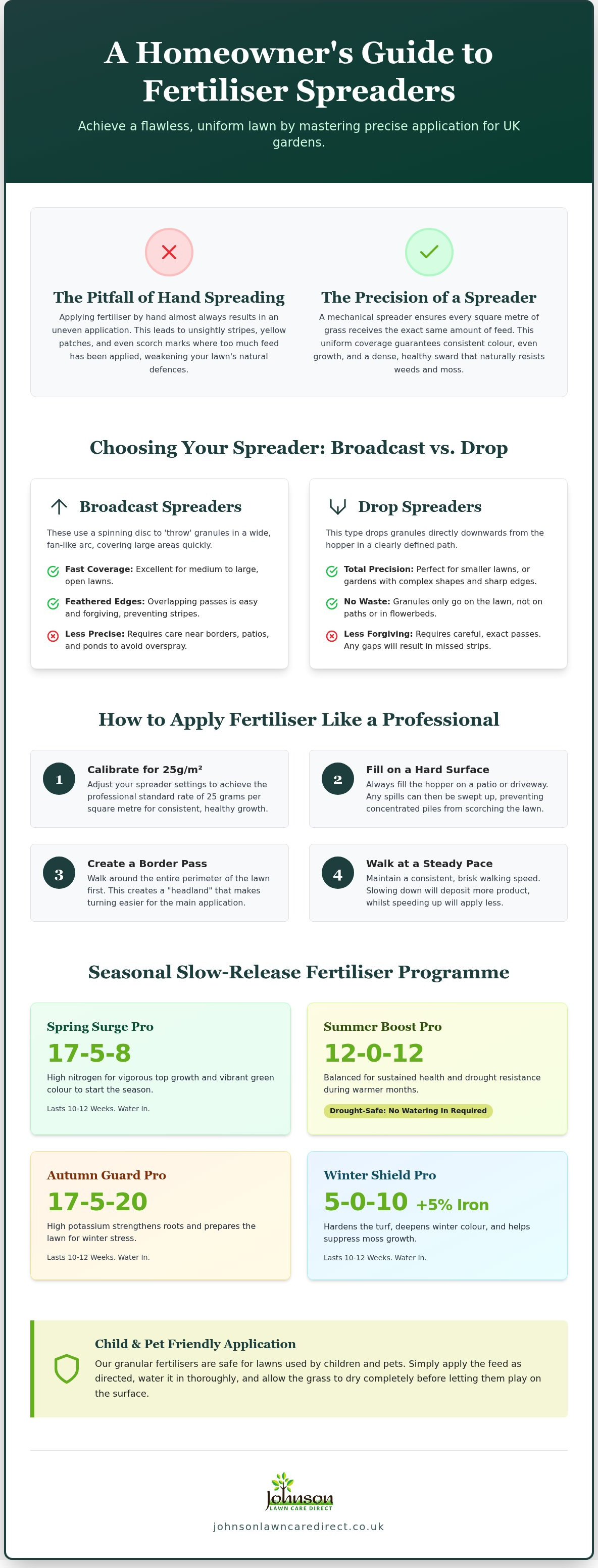
Investing in the best fertiliser spreader for UK lawns is not merely about convenience; it is about precision. A fertiliser spreader is a mechanical tool engineered to distribute granular, slow-release feeds across a grass surface at a uniform rate. Whilst it might be tempting to scatter feed by hand, this approach rarely achieves the consistency required for a professional finish. Precision is the foundation of the Lawn Envy System; it ensures that every square metre of your garden receives the exact nutrients needed for health and vitality. By using a mechanical device, often a Broadcast spreader, you can maintain a controlled flow that matches your walking pace, ensuring the grass is neither overfed nor neglected.
The Problem with Hand Application
Human error is the primary cause of disappointing results in domestic lawn care. When you apply feed by hand, it is nearly impossible to maintain a steady flow, leading to areas of over-concentration and patches of neglect. This inconsistency often manifests as striping, where dark green lines of growth sit adjacent to pale, hungry grass. In more severe cases, an accidental heavy handful can lead to nitrogen scorch, leaving unsightly brown patches that take weeks to rectify. Beyond aesthetics, uneven feeding weakens the grass sward. A healthy, dense lawn is your primary defence against weeds and moss; however, this protection only exists when the entire surface is fed consistently at the required rate of 25 grams per square metre.
How Spreaders Protect Your Grass
Spreaders provide a systematic way to deliver essential nutrients like magnesium and iron, which activate with warmth and moisture to improve the lawn. These tools allow for even coverage of professional-grade products such as Spring Surge Pro (17-5-8) or Winter Shield Pro (5-0-10 with 5% iron). By ensuring a uniform application, you support both root strength and vibrant colour across the whole garden. Each application typically lasts between 10 to 12 weeks, providing sustained nutrition that keeps the sward resilient. Choosing the best fertiliser spreader for UK lawns ensures that your seasonal maintenance is efficient and effective, protecting your investment in premium feeds and helping you achieve a thick, golf-course finish with confidence.
Comparing Broadcast and Drop Spreaders for UK Gardens
Selecting the best fertiliser spreader for UK lawns requires an understanding of how different mechanisms interact with your garden's layout. There are two primary categories to consider: broadcast spreaders and drop spreaders. Whilst both tools are designed to apply granular, slow-release feeds, they distribute the product in fundamentally different ways. Your choice will influence how quickly you finish the task and how much control you have over where the nutrients land. Most UK gardens benefit from one type over the other depending on whether you prioritise speed or pinpoint accuracy near delicate borders.
Broadcast Spreaders for Large Lawns
Broadcast spreaders, often called rotary spreaders, utilise a spinning disc at the base of the hopper to throw granules in a wide, fan-shaped arc. This design makes them exceptionally efficient for covering large, open areas of grass. Because the distribution tapers off at the edges of the arc, it creates a feathered effect that allows for overlapping passes without creating visible lines of over-application. However, this wide throw requires careful management near flower beds or gravel paths. You must be mindful of your proximity to boundaries to ensure that nitrogen-rich granules do not end up in your borders. For those managing substantial lawns, the speed and coverage offered by a rotary model are often superior.
Drop Spreaders for Precise Boundaries
Drop spreaders operate on a simpler gravity-fed principle, releasing fertiliser directly beneath the hopper in a path exactly the width of the tool. This makes them the ideal choice for smaller urban lawns or gardens with intricate shapes and numerous hard edges. They provide total control, ensuring that every granule of your seasonal feed stays on the grass rather than being wasted on a patio or driveway. The trade-off for this precision is the requirement for absolute accuracy in your walking lines. Because there is no feathered edge, any gap between your passes will result in a pale strip of underfed grass.
Regardless of the type you choose, the effectiveness of your maintenance programme relies on accuracy. Calibrating your fertilizer spreader is a vital step to ensure you are delivering the professional standard of 25 grams per square metre. This precision ensures that your grass sward receives the consistent nutrition needed to stay dense and healthy throughout the year. Choosing the best fertiliser spreader for UK lawns is a vital decision for any homeowner aiming for a uniform, dark green finish. Once you have selected your equipment, integrating it into a structured routine like the Lawn Envy System will help you achieve results that last for 10 to 12 weeks.
Choosing the Best Spreader Based on Your Lawn Size
Selecting the best fertiliser spreader for UK lawns is a task that begins with a simple measurement: the total area of your grass. Whilst many industrial guides focus on massive hoppers designed for sports pitches, the typical British garden requires a more nuanced approach. Using a tool that is too large for a compact urban space makes precision difficult; conversely, a tool that is too small for a sprawling country lawn leads to fatigue and inconsistent application. Professional outcomes are achieved when the equipment is correctly scaled to the environment, allowing you to maintain the required 25 grams per square metre application rate with ease. Because our feeds are exclusively granular and slow-release, they rely on this mechanical consistency to activate correctly with warmth and moisture.
Handheld Spreaders for Compact Spaces
For homeowners with small urban lawns under 100 square metres, a handheld unit is often the most practical choice. These devices are lightweight and take up minimal space in a garden shed. They are particularly effective for applying seasonal treatments such as Spring Surge Pro (17-5-8) to front gardens or small rear patches. Most models are either hand-cranked or battery-operated, providing a simple way to distribute granules without the need for a bulky wheeled unit. Because these tools rely on your arm movement, it is essential to understand how to calibrate your spreader to ensure you don't over-concentrate the nitrogen in one spot, which can lead to scorching.
Wheeled Push Spreaders for Professional Results
Once a lawn exceeds 100 square metres, a wheeled push spreader becomes a necessity for maintaining consistency. These tools provide a stable platform that removes much of the human error associated with handheld devices. A steady walking pace is the key to a uniform flow of granules; the mechanical link between the wheels and the distribution disc ensures the feed is applied evenly. When selecting a wheeled model, look for units with large, durable wheels that can navigate the often uneven terrain found in UK gardens. This stability helps you achieve a thick, dark green finish that stays healthy for 10 to 12 weeks. Using a wheeled spreader also makes it easier to follow a systematic path, which is a core part of achieving a golf-course standard at home. It's a reliable way to ensure your lawn remains dense, providing the primary defence against weeds and moss.
How to Apply Lawn Fertiliser Like a Professional
Achieving a thick, healthy lawn requires more than just high-quality feed; you must also master the application using the best fertiliser spreader for UK lawns. Professional results depend on a systematic approach that ensures every blade of grass receives the same level of nutrition. Before you begin, set your equipment to the rate recommended for the Lawn Envy System, which is 25 grams per square metre. It's a common mistake to fill the hopper whilst standing on the grass. Instead, always fill your spreader on a hard surface like a patio or driveway. This simple precaution prevents accidental spills that would otherwise cause concentrated nitrogen scorch on your lawn.
Your walking speed is a critical factor in application accuracy that many homeowners overlook. Most spreaders are calibrated for a brisk, steady walking pace of approximately three miles per hour. If you walk too slowly, the granules will pile up in a narrow strip; if you move too quickly, the coverage will be thin and patchy. Maintain a consistent tempo to ensure the mechanical distributor operates at its intended speed. Because our feeds are granular and slow-release, they rely on this even distribution to provide sustained nutrition for 10 to 12 weeks, supporting both root strength and vibrant colour.
The Professional Walking Pattern
To achieve a uniform finish, start by walking two "header" passes around the entire perimeter of your lawn. This creates a buffer zone that allows you to turn the spreader on and off as you reach the edges without missing spots or double-dosing the borders. Once the perimeter is complete, move back and forth in straight lines across the main area of the grass. Aim for a slight overlap between each pass. If you are using a broadcast spreader, the feathered edge of the arc is designed to blend with the previous row, preventing the pale strips often seen after amateur applications. Using the best fertiliser spreader for UK lawns in a methodical pattern ensures a dense sward that acts as your primary defence against weeds and moss.
Timing and Conditions for Spreading
Timing your application around the weather is the most effective way to activate the nutrients in your seasonal feed. Granular fertilisers require warmth and moisture to begin their work; therefore, applying ahead of predicted rain is ideal. If the forecast remains dry, you must water the feed in within 48 hours, unless you are using Summer Boost Pro (12-0-12), which features a drought-safe coating. Always mow the lawn before you apply fertiliser, but remember the one-third rule: never remove more than a third of the grass height at once. Once the feed has been watered in and the grass is dry, the area is completely child and pet friendly.
The Lawn Envy System: Your Path to a Perfect Lawn
A high-quality spreader is only as good as the fertiliser you put inside it. Even the best fertiliser spreader for UK lawns cannot compensate for poor-quality nutrition or inconsistent application. To achieve a golf-course standard at home, you must combine precision equipment with a structured nutritional programme. The Lawn Envy System provides a year-round plan with professional-grade, granular, slow-release feeds designed specifically for the British climate. Choosing a system that includes a precision fertiliser spreader removes the guesswork from lawn care, ensuring that every square metre of your garden receives the exact 25 grams of nutrition required for optimal health.
Consistent feeding across the seasons is the secret to a healthy, dense lawn that naturally resists weeds and moss. When the grass sward is thick and vibrant, it leaves little room for unwanted species to establish themselves. Our system focuses on building both vibrant colour and deep root strength, as both are equally important for a resilient garden. By following a methodical routine, you move away from the frustration of patchy growth and towards a predictable, high-standard outcome that becomes the envy of the neighbourhood. Each application in our programme lasts between 10 to 12 weeks, providing sustained nutrition that keeps the lawn resilient against the changing UK weather.
Seasonal Feeds for Year-Round Health
Our programme is built around seasonal requirements, ensuring your grass has the right nutrients as they are needed. Use Spring Surge Pro (17-5-8) to kickstart growth as the weather warms; its nitrogen-rich formula encourages a rapid recovery from winter dormancy. As we move into the hotter months, apply Summer Boost Pro (12-0-12) for drought-safe nutrition. This is our only feed that requires no watering in due to its specialised coating; all other feeds should be applied ahead of rain or watered in within a couple of days. To prepare for the colder months, Autumn Guard Pro (17-5-20) helps build significant root strength, ensuring the lawn can withstand the frost and damp of a British winter.
Why a System Beats One-Off Feeding
Adopting a complete system ensures you never miss a critical feeding window. Whilst one-off applications might offer a temporary green-up, a structured programme provides the cumulative benefits of consistent nutrition. The system is supported by the Lawn Envy Masterclass, which offers expert guidance to help you understand the specific needs of your grass. This education, combined with the best fertiliser spreader for UK lawns, empowers you to maintain your garden with professional confidence. A healthy, dense lawn is a long-term investment in your home's aesthetic, and once the feed has been watered in and dried, the area remains completely child and pet friendly for your peace of mind.
Achieve a Professional Finish with the Right Equipment
Transitioning from guesswork to a professional routine requires the right combination of high-standard feeds and precision equipment. You now understand that selecting the best fertiliser spreader for UK lawns is the foundation of a uniform, dark green sward. By matching your tool to your garden's layout and maintaining a steady, brisk walking pace, you ensure every square metre receives its required 25 grams of nutrition. This systematic approach removes the risk of scorching whilst ensuring your lawn stays healthy for 10 to 12 weeks between applications.
As Wiltshire’s Best Lawn Care Company 2026, we stand behind the effectiveness of our granular, slow-release feeds. These professional-grade products are designed to be child and pet friendly once they have been watered in and the grass has dried. A healthy, dense lawn is your most effective defence against weeds and moss, providing lasting results that you can be proud of throughout the seasons. We are committed to helping you simplify your garden maintenance whilst achieving an exclusive, golf-course standard finish at home.
We look forward to helping you transform your outdoor space into a resilient, vibrant landscape that remains healthy for years to come.
Frequently Asked Questions
Do I really need a spreader for a small UK lawn?
A mechanical spreader is the only reliable way to ensure a uniform application, even in a compact garden. Hand spreading is notoriously inconsistent and frequently results in patchy growth or unsightly nitrogen scorch. For spaces under 100 square metres, a handheld unit is a practical investment that helps you maintain the professional standard of 25 grams per square metre across the entire sward.
What is the best setting for my fertiliser spreader?
The ideal setting varies between equipment manufacturers and depends on the specific weight and size of the granules. You should always consult the calibration chart provided with your tool to ensure you are delivering exactly 25 grams per square metre. Finding the best fertiliser spreader for UK lawns often involves performing a small test pass on a hard surface to verify the flow rate before you begin the full application.
Can I use a spreader to apply grass seed as well as fertiliser?
Most high-quality spreaders are perfectly suitable for distributing grass seed alongside granular feeds. When using a product like Seed Start Pro (6-10-8), the spreader ensures the seed is distributed evenly to prevent overcrowding or bare patches. This mechanical consistency is vital for establishing a dense, healthy lawn that acts as your primary defence against weeds and moss.
Should I buy a broadcast spreader or a drop spreader?
Your decision should be based on the size of your lawn and the complexity of your garden borders. A broadcast spreader is highly efficient for covering large, open areas quickly by throwing granules in a wide arc. Conversely, a drop spreader offers superior precision for gardens with intricate flower beds or paths, ensuring that no fertiliser is wasted on non-grass surfaces.
How do I avoid burning my lawn when using a spreader?
You can prevent lawn burn by ensuring the hopper is never open whilst the spreader is stationary. Always start walking before you engage the feed mechanism and close it firmly before you stop or turn. Additionally, filling your equipment on a patio rather than the grass eliminates the risk of accidental concentrated spills, which are the most common cause of nitrogen scorch in domestic gardens.
Do I need to water in my fertiliser after using the spreader?
Most granular, slow-release feeds require moisture to activate and must be watered in within 48 hours if it does not rain. The only exception in our range is Summer Boost Pro (12-0-12), which features a drought-safe coating. For all other seasonal feeds, applying ahead of predicted rain is the most efficient way to ensure the nutrients reach the root zone. Once watered in and dry, the lawn is safe for children and pets.
How do I maintain and clean my fertiliser spreader?
Regular cleaning is essential because fertiliser residues can be corrosive to the mechanical parts of your spreader over time. After each use, wash the hopper and distribution disc thoroughly with a garden hose to remove any remaining dust or granules. Ensure the tool is completely dry before storing it in a shed or garage, and occasionally lubricate the moving parts to maintain a smooth, consistent flow for your next application.
What should I do if I spill fertiliser on my lawn while filling the spreader?
If a spill occurs, you must clear the concentrated granules immediately using a brush and shovel or a vacuum. Once the bulk of the product is removed, heavily saturate the area with water to dilute any remaining nitrogen that could scorch the roots. This quick action protects the grass sward and ensures the area remains child and pet friendly once the moisture has dried.
Disclaimer
The guides in our Lawn Care Library offer general lawn care information for UK homeowners. Every lawn is different, and factors such as soil, grass type, aspect and local conditions all affect what yours needs. For advice tailored specifically to your own lawn, take a look at our Personalised Lawn Envy Plan, or get in touch and we will be glad to help.


