


Most homeowners believe that achieving a golf course finish requires constant work, but the secret actually lies in doing less, more effectively. You have likely stood in a garden centre feeling overwhelmed by rows of colourful boxes, each promising a miracle but offering little clarity on how often to fertilise lawn UK gardens actually need. It's frustrating to invest your weekend and your budget into products only to see the grass scorch or the lush green fade within a fortnight.
We understand that you want a simple, automated routine that produces results you can be proud of. This guide provides the precise professional feeding programme required to maintain a lush, healthy lawn throughout the British seasons using reliable methods. We will explain how a consistent cycle of granular, slow-release nutrition every 10 to 12 weeks builds stronger roots and a dense, vibrant sward. From the initial boost of Spring Surge Pro to the drought-safe protection of Summer Boost Pro, you will discover how to keep your lawn thriving whilst spending less time worrying about the details.
Key Takeaways
- Master the four-feed annual cycle to understand exactly how often to fertilise lawn UK gardens for a consistent, professional finish.
- Learn how slow-release, granular fertilisers provide steady nutrition for up to 12 weeks, avoiding the risks of surge growth and leaf scorch.
- Identify the best times to apply seasonal products like Spring Surge Pro and Summer Boost Pro to support root strength and vibrant colour.
- Discover how soil type and your mowing routine influence nutrient retention and overall lawn health.
- Simplify your garden maintenance with the Lawn Envy System, which delivers professional-grade feeds on a schedule tailored to the British climate.
Understanding Fertilisation Frequency: Why Your Lawn Needs Regular Feeding
A healthy lawn is a living ecosystem that requires a consistent supply of nutrients to remain resilient against the British weather. Many homeowners struggle with the question of how often to fertilise lawn UK gardens; often waiting until the grass looks pale or thin before taking action. This "boom and bust" approach leads to uneven growth and a weak root system. By understanding the biological needs of your grass, you can move away from reactive maintenance and towards a proactive system that produces a dark green, golf-course finish. Professional lawn care is not about a one-off green-up; it's about maintaining a nutritional baseline that allows the grass to thrive every day of the year.
The 10 to 12 Week Nutrient Cycle
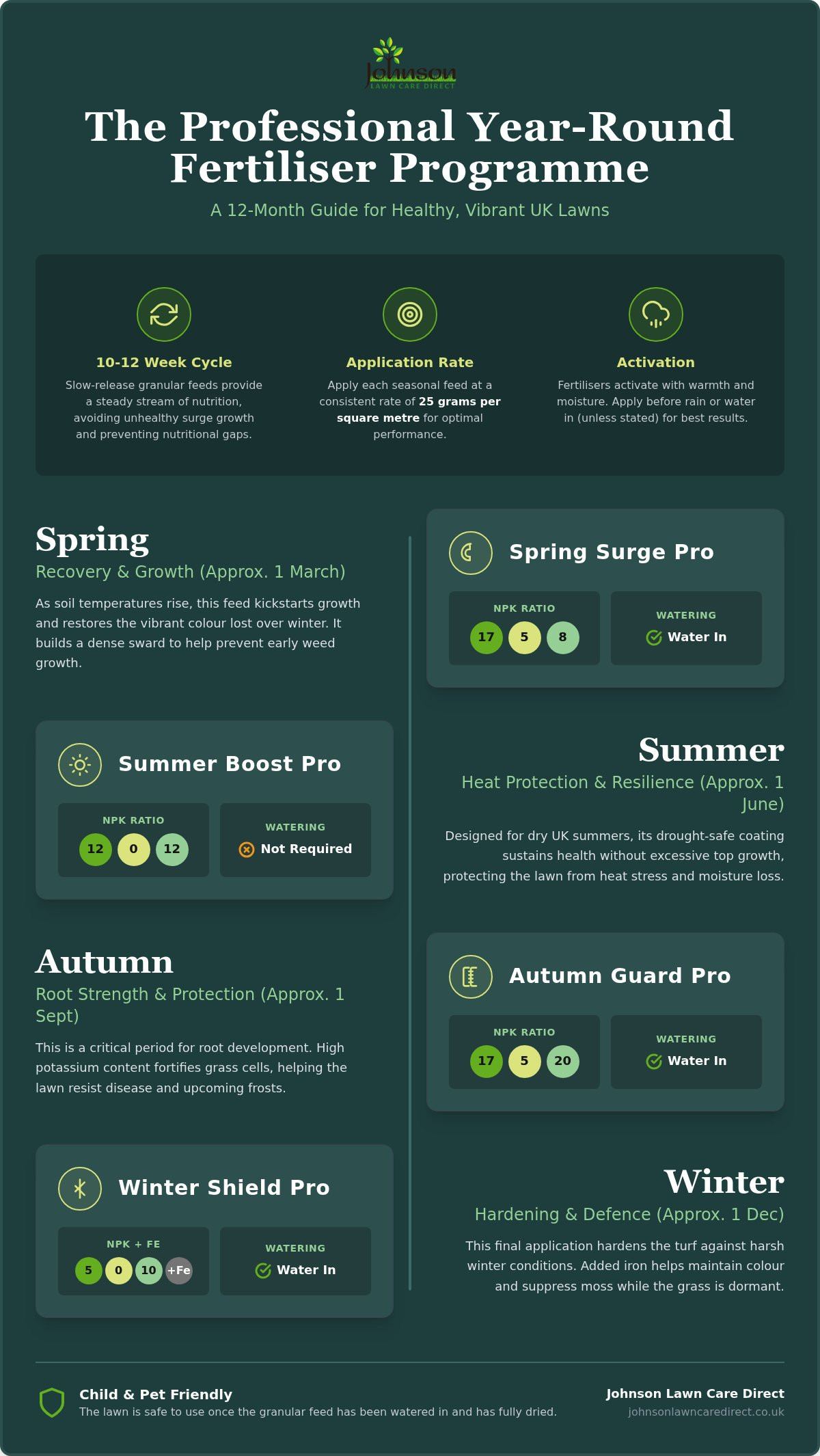
Standard retail products often use quick-release nitrogen, which causes a sudden spike in growth followed by a rapid decline. This surge growth forces you to mow more frequently and can actually exhaust the plant. In contrast, the professional granular fertilisers used in the Lawn Envy System are engineered with slow-release technology. Each application, applied at 25 grams per square metre, provides a steady stream of nitrogen, phosphorus, and potassium for 10 to 12 weeks. This longevity ensures there are no nutritional gaps; allowing the grass to build a dense sward that naturally outcompetes moss and weeds.
Warmth and Moisture: The Real Triggers for Feeding
Whilst it's tempting to follow a rigid calendar, the unpredictable UK climate requires a more nuanced approach. Fixed dates like the first of April can be misleading if the ground is still frozen or if a late frost is expected. Fertilisers activate with warmth and moisture; they don't work on a fixed timetable. You should wait for the first signs of active growth in spring before applying your first feed. Moisture is equally critical; granular fertilisers must be watered in within a couple of days to reach the root zone. The only exception in our programme is Summer Boost Pro, which features a drought-safe coating that does not require immediate watering. For all other feeds, applying ahead of forecast rain is an efficient way to ensure the nutrients are carried deep into the soil where they can be absorbed by the roots.
The Professional UK Feeding Calendar: When to Apply Each Feed
To achieve professional results, you must move beyond occasional applications and adopt a year-round nutritional strategy. Most homeowners ask how often to fertilise lawn UK gardens because they have seen the grass fade during the height of summer or succumb to moss in January. A four-feed programme solves this problem by providing a continuous supply of nutrients that adapt to the changing needs of the grass. This consistent cycle ensures your lawn never enters a period of nutritional deficiency; keeping it resilient against foot traffic and environmental stress throughout every month of the year.
Spring and Summer: Growth and Resilience
The growing season begins with recovery. Around 1 March, or as soon as the soil temperatures consistently rise and the grass shows signs of active growth, apply Spring Surge Pro (17-5-8). This formula kickstarts growth and restores the vibrant colour lost during the winter dormancy. It builds the initial density required to prevent weed seeds from taking hold in early spring; creating a thick sward that protects the soil.
As we transition into the warmer months, the focus shifts to heat protection. Around 1 June, apply Summer Boost Pro (12-0-12). This product is specifically designed for the UK's increasingly dry summers. It features a unique drought-safe coating that requires no watering in; making it safe to apply even during periods of low rainfall. This feed sustains health without causing the excessive top growth that leads to heat stress and moisture loss.
Autumn and Winter: Protection and Strength
Many amateur gardeners stop feeding in late summer, but the professional approach treats the cooler months as a critical period for root development. Around 1 September, apply Autumn Guard Pro (17-5-20). The high potassium content in this formula fortifies the grass cells; helping the lawn resist disease and the upcoming frosts whilst preparing the roots for the cold months ahead.
Finally, around 1 December, apply Winter Shield Pro (5-0-10). This winter feed includes 5% iron to suppress moss whilst providing just enough nutrition to maintain a healthy green hue. For effective moss management, we recommend an application rate of 35 to 40 grams per square metre. By maintaining this schedule, you ensure your lawn remains strong throughout the darkest months. If you prefer a hands-off approach, the Lawn Envy System automates this entire calendar for you by delivering the right feed exactly when your grass needs it.
Factors That Influence How Often You Should Fertilise
Whilst a consistent four-feed programme provides the ideal nutritional baseline, several environmental and maintenance factors can influence how your grass consumes those nutrients. Understanding these variables helps you refine your approach and ensures you achieve the best possible results from your efforts. Individual garden conditions dictate exactly how often to fertilise lawn UK properties to maintain peak health; especially when dealing with unpredictable weather patterns or specific soil challenges.
Soil Composition: Clay versus Sandy Soils
Your soil type acts as the storage bank for your lawn's nutrition. Sandy soils are common in many coastal and southern regions of the UK. They are highly porous; which means water and dissolved nutrients can leach through the root zone very quickly. If your garden has sandy soil, you may find the grass loses its lustre faster than a lawn on heavier ground. In these conditions, sticking strictly to a 10 to 12 week cycle is vital to prevent the grass from starving.
Clay soils are the opposite. They are dense and hold onto nutrients effectively, acting as a reservoir for your fertiliser. However, clay is prone to compaction, which can prevent granular feeds from reaching the roots. Regular aeration in spring or autumn is essential for clay-heavy lawns to ensure that warmth and moisture can activate the feed. For a deeper look at how these nutrients interact with different soil environments, see our guide on Understanding NPK: A Professional Guide.
The Impact of Mowing and Watering
How you maintain your grass between feeds significantly impacts its nutrient requirements. We always recommend the one-third rule; never remove more than a third of the grass height during a single mow. Scalping the lawn is a common mistake that shocks the plant and forces it to rapidly deplete its nutrient reserves to regrow. This increased demand can make your fertiliser appear to "run out" sooner than expected.
Watering habits also play a role in nutrient uptake. Light, daily sprinkling often keeps the surface damp but fails to move the fertiliser down to the roots. We advocate for deep, infrequent watering. This method encourages the roots to grow deeper into the soil to find moisture; making the plant more resilient and better able to access the slow-release nutrients provided by professional granular feeds. During the summer, leaving short clippings on the lawn can return up to 25% of the nitrogen back to the soil, providing a natural boost between your scheduled applications.
Common Mistakes in Lawn Fertilisation Frequency
Many homeowners find the question of how often to fertilise lawn UK gardens difficult to answer, leading to common errors that compromise the health of the grass. The most frequent mistake is over-feeding, particularly with high-nitrogen retail products. This often results in leaf scorch, where the concentrated salts in the fertiliser dehydrate the grass blades and turn them brown. Conversely, under-feeding is equally damaging. A lawn that lacks a consistent supply of nutrients becomes thin and patchy, creating the perfect environment for opportunistic weeds and moss to take hold. Using the wrong NPK ratio for the season is another pitfall. Applying a high-nitrogen spring feed in late autumn can force the plant to produce soft, lush top growth that is easily killed by the first winter frost.
Avoiding the 'Boom and Bust' Cycle
Cheap, fast-acting fertilisers are the primary cause of the 'boom and bust' cycle. These products release their nutrients all at once, resulting in a rapid green-up that looks impressive for a week but fades quickly. This leaves the grass starving and vulnerable. Professional granular, slow-release feeds provide a steady growth rate that is much easier to manage. You can tell your lawn is hungry between scheduled feeds if the colour begins to fade from a deep emerald to a pale green, or if the grass blades feel thinner and less resilient underfoot. Maintaining a consistent 10 to 12 week schedule prevents these nutritional dips and ensures the sward remains dense enough to resist weed invasion.
Safety for the Whole Family
Safety is a priority for any homeowner. Our granular fertilisers are child and pet friendly once they have been watered in and the lawn has completely dried. This ensures that the granules have dissolved into the soil and are no longer accessible on the surface. For those with grazing pets like rabbits or guinea pigs, we recommend keeping them off the treated area for four weeks after application. To ensure you apply the correct amount and avoid overlapping, which can cause scorch, it is worth Mastering the Fertiliser Spreader to achieve even coverage across the entire garden. Precision in application is just as important as the frequency of the feed itself.
The Simple Solution: Automating Your Lawn Care Frequency
Deciding how often to fertilise lawn UK gardens shouldn't be a source of stress or confusion. Whilst the science of soil nutrition and seasonal NPK ratios is complex; the application of that knowledge can be straightforward. The Lawn Envy System removes the guesswork by delivering the correct feed exactly when your grass requires it. By following a structured programme; you ensure that your lawn receives a consistent supply of nutrients without the risk of over-feeding or missing a critical seasonal window.
Every subscriber receives a personalised plan tailored to their specific garden needs; along with exclusive access to the Lawn Envy Masterclass. This educational resource provides the same professional methods used on award-winning lawns; broken down into manageable phases. Achieving a dark green; dense lawn like a professional golf course is a realistic goal for any homeowner when they have the right tools and a systematic routine.
The Benefits of a Subscription Programme
One of the greatest challenges in lawn care is consistency. It is easy to forget a feed during a busy summer or a cold winter; but these gaps in nutrition allow moss and weeds to gain a foothold. Our automated dispatch schedule takes the guesswork out of how often to fertilise lawn UK soil by ensuring your seasonal feeds arrive on your doorstep just as the previous application's effectiveness begins to wane. This continuous coverage maintains root strength and colour throughout the year.
Choosing the subscription model also offers practical advantages. You save 10% compared to purchasing individual seasonal feeds; making professional-standard care more accessible. Furthermore; you gain the peace of mind that comes from expert support. Janet Johnson and the team provide bespoke lawn analysis; helping you understand your soil and grass behaviour more clearly. This partnership ensures you are never alone in your journey toward domestic excellence.
The Green-up Guarantee
We believe that every garden has the potential for beauty. Our Green-up Guarantee is a commitment to that belief. If you follow our directions and use our granular; slow-release fertilisers as part of the system but see no improvement; we will work with you to put it right. This guarantee reflects our confidence in the 10 to 12 week nutrient cycle and the high-standard solutions we provide.
A healthy; dense lawn is your primary defence against common garden problems. Whilst products like Weedol can manage existing weeds; a well-fed sward naturally suppresses invaders by leaving them no room to grow. By automating your lawn care frequency; you are investing in a sustainable; long-term solution rather than a temporary result. This systematic approach allows you to enjoy the pride of a perfect lawn with minimal effort.
Transform Your Garden with a Professional Feeding Programme
Maintaining a vibrant, healthy lawn is a matter of precision rather than effort. By moving away from reactive treatments and adopting a consistent 10 to 12 week cycle, you provide your grass with the stability it needs to thrive. We have explored how often to fertilise lawn UK gardens to ensure no nutritional gaps occur; using seasonal granular feeds to build root strength and suppress moss. This systematic approach transforms your outdoor space into a resilient, emerald sward that naturally resists common garden challenges.
As a highly-regarded name in UK lawn care, Johnson Lawn Care Direct is dedicated to helping you achieve domestic excellence. Our professional-grade granular feeds work in harmony with the British seasons; and our system includes lifetime access to the Lawn Envy Masterclass to guide you at every step. You now have the roadmap to achieve a dark green, dense lawn that serves as the perfect backdrop for your home.
With a structured routine and the right nutrients, a golf-course finish is well within your reach. We look forward to helping you create a lawn you can be truly proud of.
Frequently Asked Questions
How many times a year should I fertilise my lawn in the UK?
You should fertilise your lawn four times a year to maintain a healthy and consistent nutrient level. A four-feed programme ensures there are no gaps in nutrition that moss or weeds could exploit. By feeding in spring, summer, autumn, and winter, you support the grass through every seasonal change. This schedule answers the common question of how often to fertilise lawn UK gardens to achieve a professional, dark green finish.
Can I fertilise my lawn every month?
Fertilising every month is unnecessary and potentially harmful when using professional granular products. These slow-release formulas are designed to provide steady nutrition for up to 12 weeks. Applying them monthly would lead to a dangerous buildup of nutrients in the soil; which can cause leaf scorch or excessive top growth. Stick to a quarterly schedule to allow the grass to absorb the nutrients at a natural, healthy pace without stress.
What happens if I miss a scheduled lawn feed?
Missing a scheduled feed creates a nutritional gap that can lead to fading colour and a thinner sward. When the grass is under-nourished; it becomes less competitive; allowing moss and weeds to move into the gaps. If you are unsure how often to fertilise lawn UK gardens after a missed application; simply resume the seasonal cycle as soon as conditions allow. Consistency is the primary factor in building long-term root strength.
Do I need to water in the fertiliser every time I apply it?
Most granular fertilisers require watering in within 48 hours to activate the nutrients and move them to the root zone. This prevents the granules from sitting on the leaf and causing scorch. The only exception in our range is Summer Boost Pro; which has a drought-safe coating and does not require immediate watering. For all other seasonal feeds; applying ahead of forecast rain is an efficient way to ensure activation and safety.
Is it possible to over-fertilise a lawn and cause damage?
Yes; it's possible to over-fertilise your lawn; which often leads to chemical leaf scorch or "burning" of the grass. Applying more than the recommended 25 grams per square metre or feeding too frequently can damage the plant and the soil. Over-feeding also causes surge growth; forcing you to mow much more often and potentially exhausting the grass. Following a professional programme prevents these issues by ensuring precise nutrient delivery and plant health.
When is the best time of day to apply lawn fertiliser?
The best time of day to apply fertiliser is during the early morning or evening when temperatures are cooler. Avoid applying granules in the middle of a hot; sunny day; as the heat can increase the risk of leaf scorch before the product is watered in. Applying in the evening is often ideal if rain is forecast for the following morning; as this allows for natural activation without the stress of direct sunlight.
How long does a professional granular fertiliser last?
A professional-grade granular fertiliser typically lasts between 10 and 12 weeks. Unlike cheap; fast-acting retail alternatives that might only last a fortnight; these slow-release formulas provide a sustained flow of nitrogen; phosphorus; and potassium. This longevity is why a four-feed annual programme is so effective. It ensures that your grass remains healthy and vibrant throughout the year without the need for constant reapplication or the risk of sudden nutrient crashes.
Should I mow the grass before or after applying fertiliser?
You should always mow your lawn before applying fertiliser. This allows the granules to reach the soil surface more easily and ensures they aren't picked up by the mower's collection box. After application; you should wait at least two to three days before mowing again. This delay gives the fertiliser time to be watered in and settle into the root zone; ensuring the grass can begin absorbing the nutrients undisturbed for maximum benefit.
Disclaimer
The guides in our Lawn Care Library offer general lawn care information for UK homeowners. Every lawn is different, and factors such as soil, grass type, aspect and local conditions all affect what yours needs. For advice tailored specifically to your own lawn, take a look at our Personalised Lawn Envy Plan, or get in touch and we will be glad to help.


